Contents
Introduction
Understanding the Purpose of Lab Cover Glass in Scientific Applications
Primary Materials Used to Make Lab Cover Glass
Why Glass Composition Matters: Performance, Accuracy, and Safety
Manufacturing Processes That Shape Lab Cover Glass Materials
Material Variations for Different Types of Lab Cover Glass
Chemical and Environmental Resistance of Lab Cover Glass Materials
How Material Choice Impacts Precision and Experimental Results
Conclusion
FAQ
Introduction
Lab cover glass is a fundamental consumable in laboratories across biology, chemistry, medical diagnostics, and material science. Despite its simple appearance, its material composition plays a decisive role in optical clarity, chemical resistance, and experimental accuracy. Understanding what lab cover glass is made of helps researchers select the right type for microscopy, sample protection, and high-precision observation. This article focuses exclusively on the materials behind lab cover glass, explaining how composition affects performance, durability, and suitability for different laboratory environments.
Understanding the Purpose of Lab Cover Glass in Scientific Applications
The primary function of lab cover glass is to protect specimens while maintaining optical integrity during microscopic observation. Unlike standard glass sheets, cover glass must meet strict requirements related to thickness uniformity, transparency, and inertness. These requirements directly influence material selection.
In microscopy, even minimal distortions in glass composition can affect light refraction, leading to inaccurate imaging or measurement errors. This is especially critical in High precision optical applications, where cover glass must interact predictably with lenses and immersion media. The material must also be thin enough to minimize optical interference while remaining mechanically stable, particularly in Ultra-thin formats.
Additionally, lab cover glass often acts as a barrier between samples and the external environment. In biological labs, it prevents contamination and evaporation. In chemical labs, it must withstand exposure to solvents, acids, or reagents without leaching ions or reacting. These functional demands shape the materials used in modern lab cover glass, making composition far more important than many users realize.
Primary Materials Used to Make Lab Cover Glass
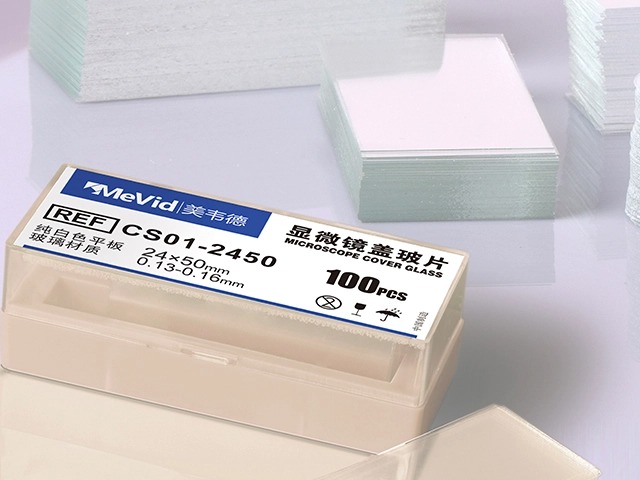
Most lab cover glass is manufactured from specialized glass rather than generic soda-lime glass. The dominant material is borosilicate glass, chosen for its excellent balance of optical clarity, chemical stability, and thermal resistance.
Borosilicate glass is primarily composed of:
This composition reduces thermal expansion and improves resistance to chemical corrosion, making it ideal for Chemically resistant laboratory environments. Compared with ordinary glass, borosilicate is less prone to cracking under temperature changes and does not easily react with acids or alkalis.
In high-end applications, lab cover glass may also be made from aluminosilicate glass. This material offers increased mechanical strength and scratch resistance, which is particularly useful for automated imaging systems or repeated handling. Some advanced versions include surface treatments such as Hydrophobic coated layers, which modify surface chemistry without changing the base material.
Why Glass Composition Matters: Performance, Accuracy, and Safety
The composition of lab cover glass directly affects experimental reliability. Optical homogeneity is one of the most critical factors. Impurities or inconsistent material distribution can introduce birefringence or light scattering, compromising imaging accuracy in fluorescence or phase-contrast microscopy.
Thickness control is another material-dependent factor. For example, Square 22x22mm cover glass used in microscopy must maintain extremely tight thickness tolerances to match objective lens calibration. Even slight deviations caused by material inconsistencies can reduce resolution or cause spherical aberration.
Safety is also influenced by material choice. Inferior glass compositions may release ions into samples, interfere with staining protocols, or degrade when exposed to reagents. High-quality lab cover glass materials minimize these risks by maintaining chemical neutrality and structural integrity under routine laboratory conditions.
Manufacturing Processes That Shape Lab Cover Glass Materials
Material selection alone does not define performance; manufacturing methods are equally important. Once the base glass composition is prepared, it undergoes controlled melting and forming processes to achieve uniform density and clarity.
Float glass techniques or precision rolling are commonly used to create thin glass sheets. These processes ensure even thickness, which is essential for High precision optical performance. After forming, the glass is carefully cut into standardized shapes such as Round or square formats, followed by edge finishing to reduce chipping and microfractures.
Advanced lab cover glass may undergo additional treatments:
Thermal annealing to relieve internal stress
Chemical strengthening for enhanced durability
Surface modification to create Hydrophobic coated properties
Each of these steps interacts with the base material, meaning not all glass compositions are suitable for every manufacturing process. This is why material science and production technology are inseparable when evaluating lab cover glass quality.
Material Variations for Different Types of Lab Cover Glass
Different laboratory applications require tailored material properties. The table below illustrates how material composition aligns with common lab cover glass variants:
| Application Requirement | Material Focus | Key Benefits |
| Standard microscopy | Borosilicate glass | Optical clarity, chemical stability |
| Ultra-thin imaging | High-purity borosilicate | Minimal optical distortion |
| Automated systems | Aluminosilicate glass | Higher strength, scratch resistance |
| Liquid-sensitive samples | Hydrophobic coated glass | Reduced fluid spread |
| Aggressive reagents | Chemically resistant glass | Long-term durability |
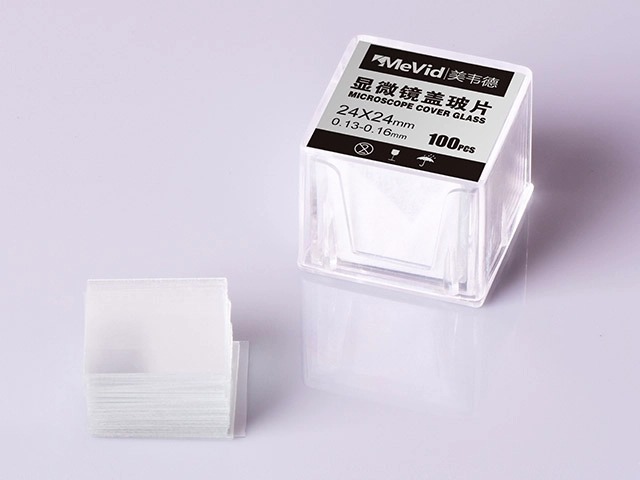
For example, Round cover glass used in specialized optical setups may prioritize stress-free material behavior to avoid polarization artifacts. Meanwhile, Square 22x22mm formats often focus on dimensional stability to support consistent imaging across large sample areas.
Chemical and Environmental Resistance of Lab Cover Glass Materials
Chemical resistance is a defining characteristic of high-quality lab cover glass. Borosilicate-based materials resist most acids, alcohols, and aqueous solutions, making them suitable for repeated cleaning and reuse. This resistance comes from the strong silica network formed during glass synthesis.
Environmental stability is equally important. Lab cover glass materials must resist humidity, UV exposure, and temperature fluctuations without clouding or degrading. In humid biological labs, poor-quality glass may develop surface haze over time, while properly formulated glass maintains long-term transparency.
Special coatings, such as Hydrophobic coated layers, enhance resistance by altering surface energy rather than bulk composition. These coatings rely on the underlying material’s compatibility, further reinforcing why base glass chemistry is critical.
How Material Choice Impacts Precision and Experimental Results
Material composition ultimately determines how lab cover glass performs in real experiments. Optical precision, repeatability, and data integrity all trace back to the glass itself. In fluorescence microscopy, for instance, background noise can increase if the glass contains trace impurities that autofluoresce.
In quantitative imaging or measurement-based studies, uniform refractive index is essential. High-quality lab cover glass materials ensure predictable light behavior, allowing researchers to trust their observations and measurements. This is especially true in High precision optical setups, where even microscopic defects can introduce errors.
Durability also influences workflow efficiency. Stronger materials reduce breakage, minimize sample loss, and lower contamination risks. Over time, selecting the right lab cover glass material becomes a strategic decision that affects both experimental outcomes and laboratory productivity.
Conclusion
Lab cover glass is far more than a transparent accessory—it is a carefully engineered material designed to support accuracy, safety, and reliability in scientific work. Most lab cover glass is made from borosilicate or aluminosilicate glass, chosen for their optical clarity, Chemically resistant properties, and mechanical stability. Variations such as Ultra-thin, Hydrophobic coated, Round, or Square 22x22mm formats exist to meet specific experimental demands. By understanding what lab cover glass is made of, researchers can make informed choices that directly enhance the quality and consistency of their results.
FAQ
1.What is the most common material used in lab cover glass?
Borosilicate glass is the most widely used material due to its balance of optical clarity, chemical resistance, and thermal stability.
2.Why does material purity matter in lab cover glass?
High purity reduces optical distortion, prevents chemical interaction with samples, and ensures consistent experimental results.
3.Are all lab cover glasses chemically resistant?
Not all. High-quality Chemically resistant lab cover glass is specifically formulated to withstand exposure to acids, solvents, and cleaning agents.
4.What makes ultra-thin lab cover glass different?
Ultra-thin lab cover glass uses highly controlled glass composition and manufacturing to minimize thickness while maintaining strength and optical performance.
5.Does coating change the base material of lab cover glass?
No. Coatings like Hydrophobic coated layers modify surface properties but rely on stable underlying glass materials for effectiveness.


