Contents
Introduction
What a Microtome Blade Is and Why It Matters
Core Functions and Working Principles of a Microtome Blade
Types of Microtome Blade by Profile and Material
How Microtome Blades Are Used Across Scientific and Medical Fields
Performance Factors That Define a High-Quality Microtome Blade
Handling, Safety, and Longevity of a Microtome Blade
Conclusion
FAQ
Introduction
A microtome blade is a precision cutting tool designed to produce extremely thin, uniform sections of biological or material samples for microscopic examination. It plays a foundational role in histology, pathology, life science research, and advanced material analysis. Unlike general cutting instruments, a microtome blade is engineered to deliver controlled, repeatable slices at micron or even nanometer scale, ensuring structural integrity and accurate visualization. Understanding what a microtome blade is, how it works, and why its design matters is essential for anyone involved in microscopic sample preparation, from clinical laboratories to research institutions.
What a Microtome Blade Is and Why It Matters
A microtome blade is a specialized cutting edge mounted on a microtome instrument to section specimens into thin slices suitable for optical or electron microscopy. These sections must be thin enough to allow light or electron beams to pass through the sample without distortion. The blade’s geometry, sharpness, and material directly influence section quality, diagnostic accuracy, and workflow efficiency.
What sets a microtome blade apart from standard blades is its microscopic tolerance. Even minor imperfections can cause compression, chatter, tearing, or knife marks on sections. In clinical settings, this can obscure cellular details critical for diagnosis. In research, it can compromise data reproducibility. As a result, the microtome blade is not just a consumable—it is a precision component central to analytical reliability.
Core Functions and Working Principles of a Microtome Blade
The primary function of a microtome blade is to shear a specimen cleanly at a predefined thickness while preserving its internal structure. This process relies on a balance of sharpness, rigidity, and cutting angle. When the specimen block advances toward the blade, the blade edge engages the material and removes a continuous section without crushing or dragging.
A high-quality microtome blade minimizes friction between the blade and specimen. Reduced friction lowers heat generation and prevents deformation of delicate tissues. The blade edge must remain stable under repetitive motion, particularly when sectioning harder samples such as resin-embedded tissues or polymer materials.
From a mechanical perspective, the blade works as a fixed cutting plane. Its effectiveness depends on consistent edge geometry and alignment within the microtome. Any deviation can lead to uneven thickness, which directly impacts staining quality and microscopic interpretation.
Types of Microtome Blade by Profile and Material
Different applications require different blade configurations. Microtome blades vary primarily by profile design and construction material, each offering specific advantages.
Blade Profiles
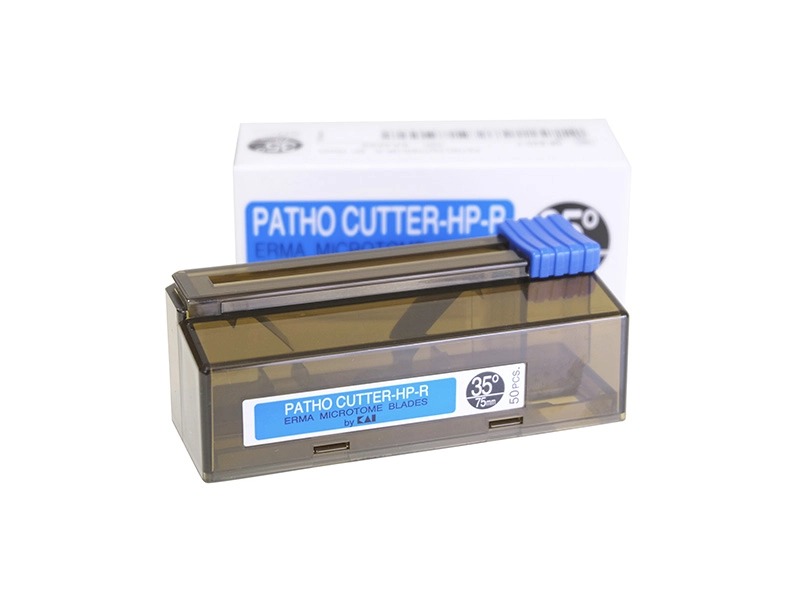
High profile microtome blade: Thicker and more rigid, suitable for harder specimens and cryosectioning. It provides enhanced stability during cutting.
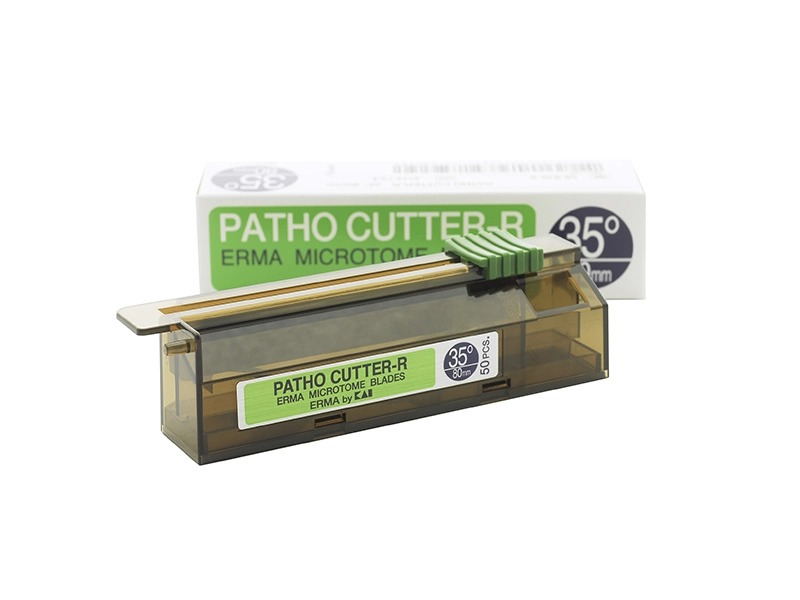
Low profile microtome blade: Thinner and more flexible, ideal for routine paraffin-embedded tissue sectioning where precision and smoothness are critical.
Blade Materials
Material selection influences durability, sharpness retention, and compatibility with specimen types.
| Blade Material | Key Characteristics | Typical Applications |
| Stainless steel microtome blade | Balanced sharpness and corrosion resistance | Routine histology and pathology |
| Tungsten carbide microtome blade | Exceptional hardness and long edge life | High-throughput labs, hard tissues |
| Diamond microtome blade | Ultra-sharp, minimal edge wear | Ultrathin sectioning, for electron microscopy |
Each microtome blade type addresses a specific cutting challenge. Selecting the correct combination of profile and material directly affects section consistency and operational efficiency.
How Microtome Blades Are Used Across Scientific and Medical Fields
The application of a microtome blade extends far beyond basic histology. In medical diagnostics, blades are essential for preparing biopsy samples, enabling pathologists to examine cellular morphology accurately. Consistent section thickness ensures reliable staining and comparison across samples.
In life science research, microtome blades support studies in neuroscience, developmental biology, and oncology. Researchers rely on predictable cutting behavior to preserve spatial relationships within tissues. For advanced imaging techniques, especially for electron microscopy, diamond-based microtome blades enable ultrathin sections that reveal subcellular structures.
Material science and industrial laboratories also use microtome blades to analyze polymers, composites, and coatings. In these contexts, blade rigidity and wear resistance are critical, as samples may be significantly harder than biological tissues.
Performance Factors That Define a High-Quality Microtome Blade
Several technical factors determine how well a microtome blade performs in real-world use. Edge sharpness is the most visible attribute, but edge stability over time is equally important. A blade that dulls quickly increases consumable costs and interrupts workflow.
Blade coating and surface finish influence friction and section smoothness. A well-engineered microtome blade reduces compression artifacts and improves ribbon formation during paraffin sectioning. Compatibility with High profile or Low profile holders also ensures secure mounting and operator safety.
Consistency between blades is another critical factor. Laboratories depend on predictable results, and variation between blades can introduce unwanted variables. For this reason, precision manufacturing and strict quality control are fundamental characteristics of reliable microtome blades.
Handling, Safety, and Longevity of a Microtome Blade
Proper handling of a microtome blade is essential for both safety and performance preservation. These blades are extremely sharp and should always be handled using designated tools or protective holders. Improper handling can damage the edge, reducing cutting quality before the blade is even used.
Storage conditions also affect blade longevity. Exposure to moisture or contaminants can compromise edge integrity, especially for Stainless steel microtome blades. For reusable options like Tungsten carbide or Diamond microtome blades, correct cleaning and storage protocols extend service life and maintain cutting precision.
From an operational standpoint, recognizing when a microtome blade should be replaced is critical. Signs such as increased cutting resistance, section tearing, or inconsistent thickness indicate that the blade has reached the end of its optimal performance window.
Conclusion
A microtome blade is a highly specialized cutting instrument that underpins accurate microscopic analysis across medicine, research, and industry. Its design, material, and profile directly influence section quality, diagnostic confidence, and experimental reliability. Understanding what a microtome blade is—and how different types serve distinct purposes—enables informed decision-making and optimized sample preparation. When selected and handled correctly, a microtome blade becomes an indispensable tool for producing precise, reproducible, and high-quality sections.
FAQ
1.What is a microtome blade used for?
A microtome blade is used to cut extremely thin sections of specimens for microscopic examination, ensuring structural clarity and consistent thickness.
5.What is the difference between High profile and Low profile microtome blades?
A High profile microtome blade offers greater rigidity for harder samples, while a Low profile microtome blade provides flexibility and precision for routine tissue sectioning.
3.Which material is best for a microtome blade?
The best material depends on the application. Stainless steel is common for routine use, Tungsten carbide offers durability for high-volume work, and Diamond microtome blades are preferred for electron microscopy.
4.How long does a microtome blade last?
Blade lifespan varies based on material, specimen type, and handling. Proper use and storage significantly extend the effective life of a microtome blade.


